


























;void(0) "pinterest")
An eyeglass prescription lists the lens powers and measurements used to make your prescription lenses. Common fields include OD and OS for the right and left eyes, SPH for spherical power, CYL and AXIS for astigmatism correction, and ADD for near-vision power. You may also see PD (pupillary distance) and Prism. Not every prescription includes every field.

What Do the Abbreviations on an Eyeglass Prescription Mean?
Eyeglass prescriptions use abbreviations and numbers to describe the lens correction prescribed for each eye. Understanding terms such as OD, OS, SPH, CYL, AXIS, ADD and PD can help you enter your prescription correctly when ordering glasses online.
Eyeglass Prescription Abbreviations at a Glance
| Term | Meaning |
|---|---|
| OD | Right eye |
| OS | Left eye |
| OU | Both eyes |
| SPH | Spherical lens power used to correct nearsightedness or farsightedness |
| CYL | Cylinder power used to correct astigmatism |
| AXIS | Orientation of the cylinder correction, measured from 1° to 180° |
| ADD | Additional near-vision power used with multifocal prescriptions |
| PD | Pupillary distance, measured in millimeters between the centers of the pupils |
| Prism | Prism correction specified by an amount and a base direction |

OD, OS and OU
You may see OD, OS and sometimes OU on an eyeglass prescription.
OD stands for oculus dexter and means the right eye.
OS stands for oculus sinister and means the left eye.
OU stands for oculus uterque and refers to both eyes.
SPH, CYL, AXIS and PD
SPH (Sphere) shows the spherical lens power in diopters. A minus value is used for nearsightedness, while a plus value is used for farsightedness.
CYL (Cylinder) shows the amount of cylinder power prescribed to correct astigmatism. If no cylinder correction is prescribed, this field may be blank or shown as zero.
AXIS shows the orientation of the cylinder correction and is written as a number from 1° to 180°. An AXIS value is used together with CYL when cylinder correction is prescribed.
PD (Pupillary Distance) is the distance, measured in millimeters, between the centers of your pupils. It helps position the optical centers of prescription lenses correctly. If your PD is not provided, see How to Measure Your PD .
ADD and Prism
ADD (Addition) is additional plus power prescribed for near vision. It is commonly used with multifocal lenses such as bifocals and progressive lenses.
Prism is an additional prescription measurement used when prism correction is prescribed. A prism prescription normally includes a prism amount and a base direction, such as base up, base down, base in or base out. Learn more about prism glasses .
Common Eyeglass Prescription Patterns
Eyeglass prescriptions can contain different combinations of SPH, CYL, AXIS and ADD values. The examples below show how some common prescription values may relate to nearsightedness, farsightedness, astigmatism and multifocal vision correction.
Nearsighted Prescription
A minus (-) value in the SPH column is commonly used to correct nearsightedness (myopia). Nearsightedness means distant objects appear blurry while closer objects may be easier to see.

Farsighted Prescription
A plus (+) value in the SPH column is commonly used to correct farsightedness (hyperopia). Farsightedness can make nearby objects appear blurry, although the effect can vary depending on the degree of farsightedness and the person's age.

Astigmatism Prescription
When CYL and AXIS values are included on a prescription, cylinder correction has been prescribed for astigmatism. CYL indicates the amount of cylinder power, while AXIS indicates its orientation from 1° to 180°. Astigmatism can occur together with nearsightedness or farsightedness.

Bifocal and Progressive Prescription
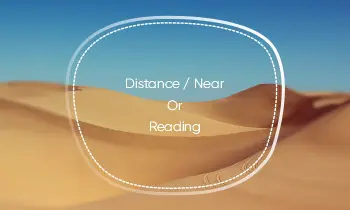
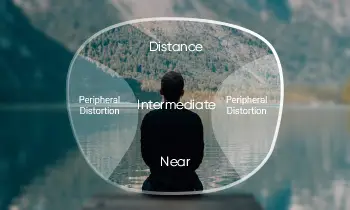
A prescription that includes an ADD value may be used for multifocal lenses when additional near-vision power is prescribed. Bifocal lenses provide separate distance and near-vision areas, while progressive lenses provide a gradual transition between distance, intermediate and near vision without a visible dividing line.

